Mark Lvovich Babad
Born Marcus Lvovich Babad, 7 February 1907, Soroca. Aviation engineer. Shot 20 January 1938, Kyiv. Rehabilitated 25 April 1958.
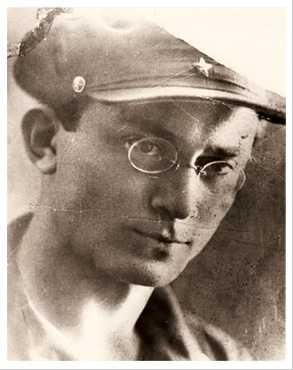
Soroca, 1907–1925
He was born Mark-Markus Lvovich Babad — the doubled given name preserved in his own first interrogation testimony of 24 October 1937 — in Soroca, a Jewish town on the high right bank of the Dniester River in northern Bessarabia. The town had passed from the Russian Empire to the new Kingdom of Romania at the end of the First World War; from 1918 to 1940 it sat inside Romania. His mother's name was Elizaveta Uriel; his father's first name, Lev, gave him the patronymic Lvovich. He had a brother, Aaron, and a sister, both of whom remained in Bessarabia. The family appears in the case file in fragments: a maternal name on a confession sheet, a brother's name in an interrogation about Bessarabian acquaintances, the bare fact of a sister.
The crossing, 1925–1926
He crossed into Soviet territory in 1925 — one of the wave of Bessarabian Jews who, between 1924 and 1926, made the crossing to the USSR for political and economic reasons that the Soviet authorities later treated as inherently suspect. He was briefly detained by the GPU in 1926 and released under "fourteen points and amnesty" — the standard amnesty and registration procedure for irregular border crossers in the period. His own answer to question 14(b) on the October 1937 detainee questionnaire — "Was under investigation in 1926" — survives in his hand.
The 1925 crossing and the 1926 detention will return as evidence in 1937. The "Romanian past" was the structural reason the case against him took the shape it did: not as a personal accusation but as participation in a category — Bessarabian Jews under NKVD Order 00485 — whose membership was itself the charge.
BELKOM, MAI, the aviation industry, 1928–1937
From 1928 to June 1934 he was a member of "БЕЛКОМ" — most plausibly a Bessarabian or Moldavian communist youth organization, the abbreviation never resolved with full confidence in the file. He took higher education at the Moscow Aviation Institute, the elite Soviet aerospace engineering school founded in 1930, graduating into the technical-intelligentsia cadre of the Soviet defense industry.
His first appointment was to Moscow Aviation Factory No. 1. He moved to Kyiv to Aviation Factory No. 43, the Kyiv aircraft works, where he held a senior engineering position. By 1937 he had begun preparing a doctoral dissertation for defense at the USSR Academy of Sciences and held a concurrent academic-administrative role as Academic Secretary of the All-Ukrainian Institute of Structures in Kyiv. The professional record is the record of a thirty-year-old engineer on an upward technical-academic trajectory, with the institutional life of the Soviet aviation industry entirely around him.
He married Zinaida Lazarevna Finkelshtein around 1934 — she had just graduated the Moscow Conservatory as a pianist and would soon take a teaching position at the Kyiv Conservatory.
Arrest, sentence, execution, October 1937 – January 1938
The full procedural record is on the case page. The bare chronology: investigation opened 20 October 1937 (with the espionage-on-behalf-of-Romania charge already pre-formed); search and seizure 23 October; first interrogation 24 October; confession (signed) 4 November; sentenced to death by the "Two" under Protocol No. 72 on 23 December; shot at midnight on the night of 19–20 January 1938 in the basement of the NKVD UkrSSR internal prison on Institutska Street, Kyiv. He was thirty.
The twenty-year silence, 1938–1958
The family was told nothing. The standard fiction — "ten years without right of correspondence" — was the universal Soviet euphemism for execution by shooting in 1937–38, and Zinaida and Lidia, like every other shooting widow and shooting orphan of the period, lived inside it. Lidia was born five months after the execution and grew up not knowing whether her father was alive.
The case was reopened during the Khrushchev thaw in 1957–58. The Military Tribunal of the Kyiv Military District handled the rehabilitation review; the keystone deposition was given by Kachinsky, with supporting depositions from Goldeyev, Bisnovat, and Lazarev. The 1937 sentence was annulled; rehabilitation was issued 25 April 1958, with the Tribunal's findings of 14 July 1958 entered into the case folder. The rehabilitation paperwork — and the 1937 case folder — sat thereafter in the archive of the Soviet, then Ukrainian, security services for sixty years before the family obtained the file.