The case
NKVD case file 46736 against Babad, Mark Lvovich. Three bound volumes, 296 archival sheets, ~675 page-images. Held at the Ukrainian Central State Archive of Public Associations, Kyiv (ЦДАГО, fond 263, opis 1, file 46736). Compiled October 1937 to January 1938; reopened for rehabilitation 1957–58; certified for permanent custody by the Ukrainian state archive on 28 August 2019.
The shape of the file
The file as it survives is a layered artifact. The outer folder is a modern post-1970 replacement, blank, with the stenciled fields for date and volume count never filled in. Inside it is the original 1937 case folder, surviving with case number 65665 — the number under which Babad's case was tracked by Kyiv UNKVD at the time of the investigation. The case was renumbered three times in the archive afterward: 65665 → 526758 → 755359 → 46736 (current). The accumulated stamps on the original folder are a layered timeline of the file's twentieth-century afterlife: 1940 ("joined to file" — likely a reference to materials being merged in, perhaps Zinaida's 1940 letter to Beria); 14 July 1958 (Military Tribunal of Kyiv Military District handling the rehabilitation review); 1962 (re-registration in some later inventory).
The contents break down by volume:
| Vol. | Sheets | What it holds |
|---|---|---|
| 1 | 183 | The investigation file: arrest, biographical questionnaire, interrogation protocols, the 4 November handwritten confession, the indictment, the sentence; plus the 1957–58 rehabilitation review including the keystone Kachinsky deposition and the Goldeyev / Bisnovat / Lazarev witness depositions. |
| 2 | 20 | The smaller middle volume; family correspondence preserved by the file (Zinaida's 3 November 1940 letter to Beria asking for the return of her piano sits here), and miscellaneous interim documents. |
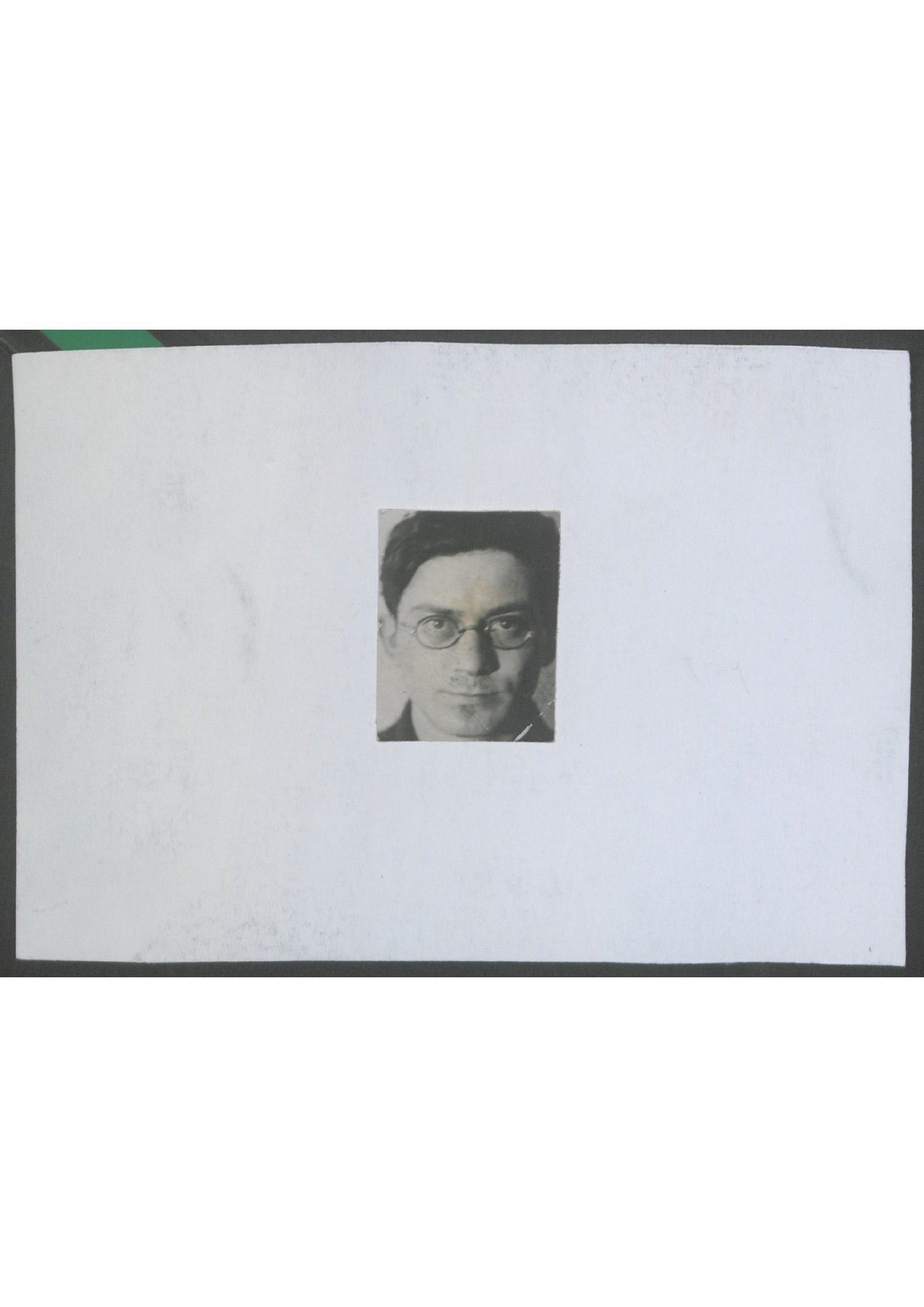
| 3 | 99 imaged / 67 sheets | The closing volume: sentencing decision, execution paperwork, rehabilitation correspondence, photographs (sheets 61–66), and the case-file portrait of Mark. |
The May 2026 translation, from which this site is being written, is the side-by-side bilingual Combined Volumes — 675 page-images, Russian transcription on the left, English translation on the right, with paleographic and procedural recheck notes threaded throughout.
The charge, pre-formed
The founding document of the case is the Resolution opening investigation, dated 20 October 1937 — a month before the arrest formally registered. The charge is stated in fully-formed shape:
The pre-formed charge sets the template the subsequent interrogations will be used to fill in. The reference to "other agents" anticipates the group framing — Babad's case is cross-linked in Volume 3 to a related case file 768117 on "Neiman, Alexander Semenovich, and others," almost certainly the group case being constructed in parallel.
Charged under Article 54-6 of the Criminal Code of the Ukrainian SSR — espionage. The arrest itself was made under NKVD Order No. 00485, the secret August 1937 directive signed by Yezhov authorizing the so-called "Polish Operation": the mass arrest and execution of Soviet citizens of Polish ethnic origin and, by extension, of Bessarabian Jews and other "foreign-element" categories. Babad's category was the trigger; the case was the procedural vehicle.
The biographical sheet
From the detainee questionnaire ("Анкета арестованного"), late October 1937, in his own hand:
- Born: 7 February 1907, Soroca, Bessarabia.
- Education: Higher. Graduated from the Moscow Aviation Institute (Московский авиационный институт — MAI).
- Party affiliation: Non-party. Was a member of "БЕЛКОМ" from 1928 to June 1934, mechanical division.
- Prior repressions: Was under investigation in 1926, but no court [sanctions]; expelled under "fourteen points and amnesty."
- Awards under Soviet power: None.
- Service in the Red Army: Did not serve.
- Service in counter-revolutionary armies: No.
- Family in Bessarabia: Mother (Elizaveta Uriel), brother Aaron, and a sister.
- Previous workplace mentioned: Krasnoyarsk Aviation Repair Plant (a 1933–34 posting between his MAI graduation and his Moscow assignment).
- Concurrent academic appointment: Academic Secretary of the All-Ukrainian Institute of Structures.
- Stated intent: To defend a doctoral dissertation at the USSR Academy of Sciences (per the engineering letter at Vol. 3 p. 65).
Interrogation and confession
The first interrogation took place on 24 October 1937, opening — per standard NKVD procedure — with the question of when and why he had crossed into Soviet territory. The interrogator's surname at the top of the protocol is hard to read; the most plausible reading combines two officers, with Lieutenant Kaminsky (firmly attested on the indictment, page 17) as the principal investigator.
The handwritten confession, signed 4 November 1937, is the nodal document of the file: it is the document on which the entire procedural edifice afterward rests. The standing question — for which a session was begun and not finished due to API errors — is how much of the file is in Babad's own hand: the questionnaire and confession at minimum, but the question of which interrogation protocols are signed-only versus written-through is open and worth a careful pass.
Sentence and execution
Sentenced to death on 23 December 1937 by the "Two" — the People's Commissar of Internal Affairs and the Prosecutor of the USSR, signing off on batched defendant lists — under Protocol No. 72. Shot at midnight on the night of 19–20 January 1938 in the basement of the NKVD UkrSSR internal prison on Institutska Street, Kyiv. The building survives today as the October Palace on the Maidan, a cultural-events venue. There is no marker.
Rehabilitation, 1957–58
The case was reopened under the Khrushchev thaw. The Military Tribunal of the Kyiv Military District handled the review. The keystone of the rehabilitation was a deposition by Kachinsky; supporting depositions were given by Goldeyev, Bisnovat, and Lazarev. The Tribunal's findings of 14 July 1958 — annulling the 1937 sentence and stating that the espionage charge had been fabricated — were entered into the case folder, where they sit today next to the 1937 indictment.
Rehabilitation was issued 25 April 1958. Babad had been dead twenty years and three months.
Photographs
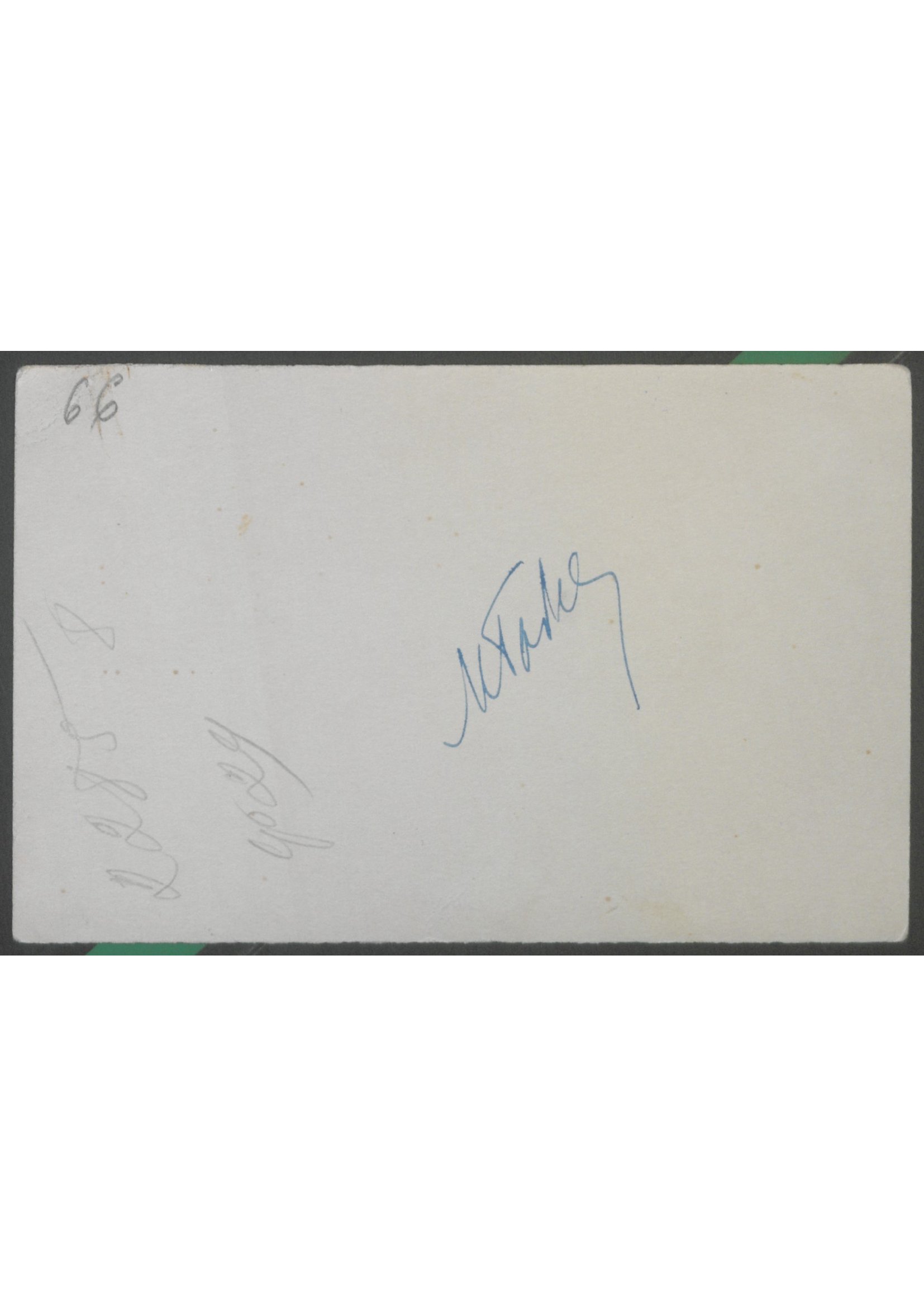
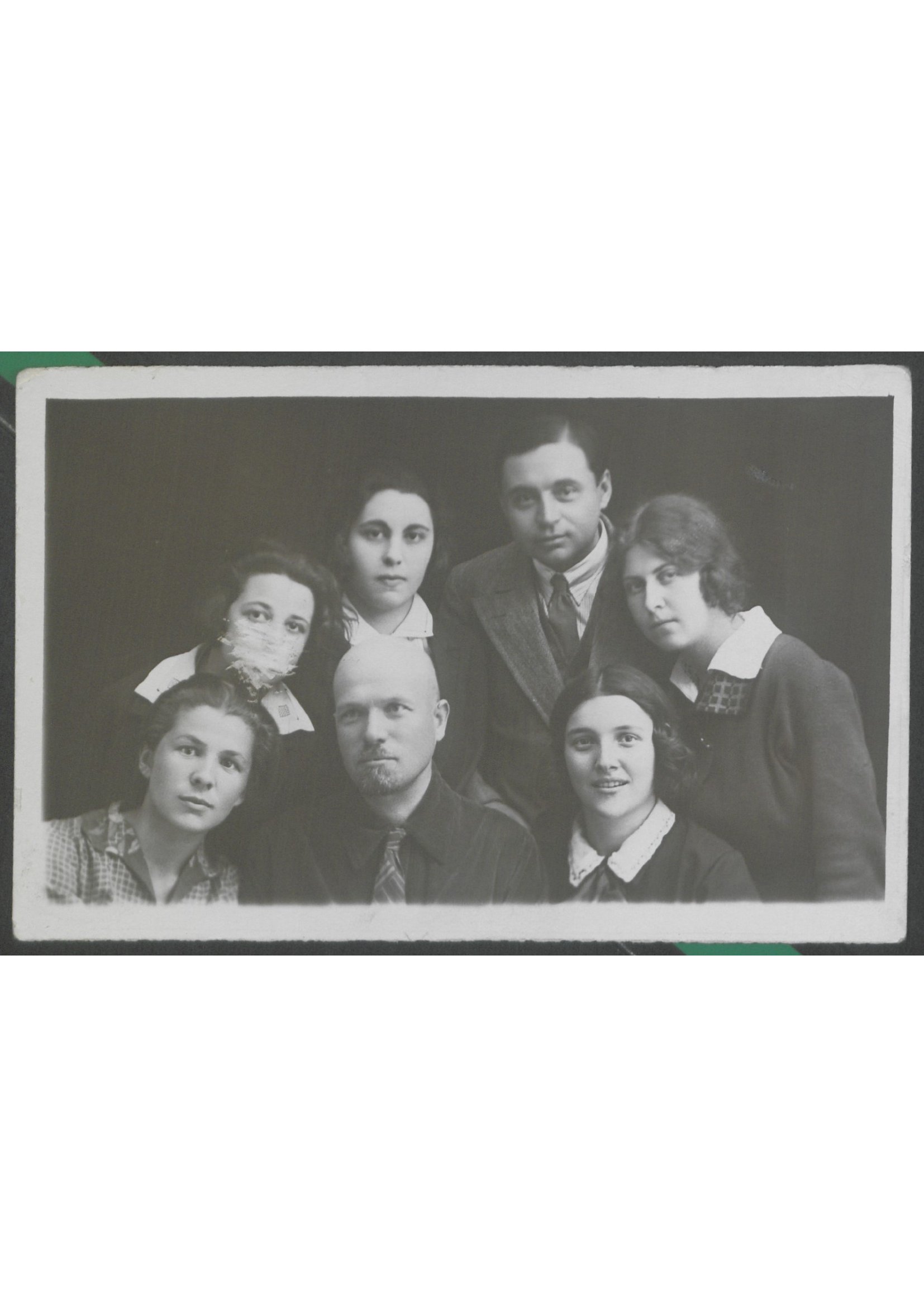
Vol. 3 contains a small cluster of photographs (sheets 61–66): a case-file portrait of Mark (below, top); one photograph with a faint blue-ink signature on its verso, possibly Mark's own, possibly a dedication (below, middle); a studio group portrait of seven (figures unidentified by family memory) with one woman's face in the back row obscured by either physical wear or — possibly — deliberate erasure of the kind that became common Soviet practice after a relative's arrest (below, bottom). The earlier reading that the back-row young man in the group portrait was Mark has been withdrawn (May 2026 paleographic recheck): the family-confirmed cap-and-glasses image of Mark does not match.
Provenance and access
The file was certified for permanent custody by the Ukrainian Central State Archive of Public Associations (ЦДАГО) on 28 August 2019, signed by Chief Specialist I. V. Yankova. Family access dates to the period after 2019, with the working translation compiled in May 2026. Files and links.